
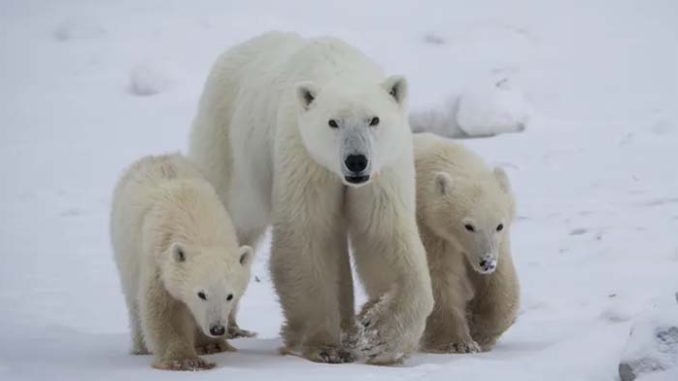
18.1.2026 – Source: Smithsonian Magazine, Photos by Dave Sandford/Discover Churchill
The rare event marks the 13th known instance of adoption within this well-studied group of polar bears living in the western Hudson Bay area.
Researchers were surprised when they spotted an additional cub with this mother polar bear.
When female polar bear X33991 first emerged from her maternal den in northeastern Manitoba this spring, she had one young cub toddling around by her side. Months later, researchers spotted X33991 again—and, this time, they were surprised to see her ambling around with two little ones in tow.
Researchers were surprised when they spotted an additional cub with this mother polar bear.

Now, scientists say they’ve confirmed a rare case of polar bear cub adoption. This is the 13th known instance within the western Hudson Bay subpopulation, which is one of the most-studied groups in the world and has included around 4,600 bears over the past 45 years.
Researchers encountered X33991 coming out of the denning area in Wapusk National Park in March, when they fitted her cub with an ear tag. In mid-November, they saw her again, walking along the coast near Churchill, Manitoba, with two cubs—one with a tag, one without. They captured the family of three on video as they wandered near Hudson Bay, where hundreds of the shaggy marine mammals congregate each fall as they wait for the sea ice to reform.

They later verified X33991 had adopted the second cub. Both youngsters are estimated to be 10 to 11 months old. The mother, which is fitted with a GPS tracking collar, is around five years old. Cubs typically stay with their mothers for around two to three years, until they are old enough to venture out onto the sea ice and hunt on their own.
Scientists don’t know what happened to the adopted cub’s biological mother, but genetic samples collected from the adopted youngster could help them find out. Its DNA might be a match for a female bear that scientists are already familiar with, and they might be able to determine whether she’s still alive.
Scientists don’t know why polar bear mothers sometimes adopt cubs.

Polar bear mothers have been known to pick up extra cubs or switch litters, so it’s possible the cub is not an orphan but, rather, simply got swapped into the care of another female.
“There must be some sort of confusion going on,” says Evan Richardson, a scientist with Canada’s environment and climate change department, in a video statement provided to media. “But we really think it’s just because they’re so maternally charged and such good mothers and they can’t leave a cub crying on the tundra, so they pick them up and take them along with them.”
Polar bear cub survival rates vary around the world but tend to hover around 50 percent for the animals’ first year. But if a cub becomes orphaned for some reason, “it has almost no chance,” says Alysa McCall, director of conservation outreach and a staff scientist with Polar Bears International.
“When we got confirmation that this was an adoption, I had a lot of mixed feelings, but mostly good,” she adds. “It gives you a lot of hope when you realize that polar bears maybe are looking out for each other out there.”
The mother bear is outfitted with a GPS tracking collar, and members of the public can keep tabs on the family as they wander across the sea ice. The adopted cub likely has a better chance of making it to adulthood. But even so, experts warn that the young bear may not survive: Of the 13 known cases in the western Hudson Bay subpopulation over the past half century, only three adopted bears have survived, per the Guardian’s Leyland Cecco.
For now, though, the family appears to be happy and healthy. GPS tracking data shows them ambling around the sea ice in Hudson Bay as expected. Polar bears spend as much time as possible walking across sea ice, where they can sneak up on their favorite prey, seals. But as the planet heats up amid global warming, sea ice is forming later in the fall and melting earlier in the spring, meaning the bears are spending more time on land.

The Arctic Ocean, where all 20 known polar bear subpopulations hunt, is estimated to be warming four times faster than the rest of the globe. Scientists estimate roughly 26,000 polar bears remain in the wild, living in places like Canada, Alaska, Russia, Greenland and Norway.

In Norway, scientists have only documented one instance of cub adoption, Jon Aars, an ecologist at the Norwegian Polar Institute who was not involved with the case in Canada, tells the Washington Post’s Victoria Bisset. However, other mammals have been known to take in orphaned young, so the behavior might be more common in polar bears than scientists think.
“The bears need all the help they can get these days with climate change,” Richardson says. “If females have the opportunity to pick up another cub and care for it and successfully wean it, it’s a good thing for bears in Churchill.”
ich finde das ganz sehr toll und berührend!!! 💓👍🥰 Dankeschön liebe Eisbärenmama!
The Hollywood film Alaska ends with an orphan cub joining a new family. Wonderful to see that it sometimes happens for real. Polar Bear mothers are superb.
Ein sehr berührender Beitrag, der mir inmitten all der schlechten Nachrichten das Herz erwärmt…🐻❄️🐻❄️🐻❄️💝😊
Dear Mervi!
Thank you for this wonderful Story.
Hugs
Ludmila
Dear Mervi!
The baby schema, in conjunction with the corresponding hormones, ensures that human and animal babies do not have to die helpless and alone if their mother is unable to care for them and another mother can step in. Nature, which can sometimes be so cruel, has arranged this well.
Thank you for this lovely story!
Hugs
Anke
Eine großartige Geschichte und Bewis für ein aussergewöhnliches Sozialverhalten der Eisbärinnen.Bleibt zu hoffen, dass das Adoptivkind überlebt!