
15.4.2026 – Source: Ranua Wildlife Park
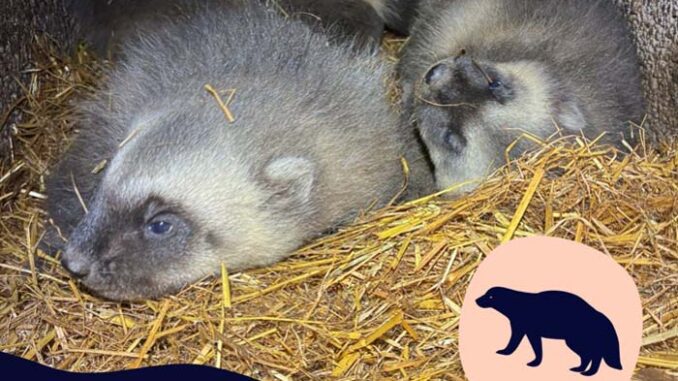
Four Wolverine cubs were born at Ranua Wildlife Park in early February. A litter of four is considered large for wolverines. At birth, wolverine babies are white and very small—so small that when the mother curls up, she is able to protect all four kits at once. Over the last months, the kits have already grown significantly. During the first weeks, the mother, Khurma, spent virtually all of her time in the den with the kits, but she now occasionally leaves them for short periods to feed and explore her surroundings.
The early kit stage is a sensitive time, and Khurma has been caring for a large family. The lives of the mother and kits were monitored via a den camera, but otherwise the den area was left undisturbed to allow the mother to care for her young in peace. The kits typically remain sheltered in the den until they are around two months old, after which they gradually and cautiously begin to explore the outside world.

The father, Julle, lives within the same enclosure complex but does not take part in rearing the kits. He keeps a respectful distance from the den and allows the mother to care for the young.
“The birth of wolverine kits is a great joy for us and an important success, as breeding wolverines in human care is often challenging,” says Heini Niinimäki, Zoological Director and Veterinarian at Ranua Wildlife Park. “Above all, following the kits’ development is rewarding both for our staff and for visitors.”
The wolverine cubs have had their check-ups, and we got their first “portraits” at the same time. This means we’re now looking for names for these four adorable little explorers! This year’s theme is playfully “fairy tale characters.” Join the naming contest from April 14–26 and help choose names that will go down in history!

In February 2026, four wolverine cubs were born at Ranua Wildlife Park. For the first few weeks, the family was able to grow in peace in their den, and when the cubs were about 7 weeks old, an important milestone arrived: a veterinary checkup. The checkup went quickly and smoothly. Mother Khurma was lured into the adjacent enclosure for a moment, and the veterinarian and animal caretaker visited the den one cub at a time.
Baby girl 1

Baby girl 2

The examination also revealed the gender of the puppies: three females and one male. The puppies’ individual identification marks were checked, they were microchipped, and they were weighed: the females weighed about 1.7–1.8 kg and the male about 2.1 kg. Their canine teeth have already started to come in, so they can begin tasting solid food. After the checkup, the puppies returned to the nest next to their siblings, and Khurma was let back in with them. The new smells puzzled them for a moment, but soon the family calmed down and settled in for a rest.
Baby girl 3

Baby boy

The Spring has arrived in Ranua although there are still big ice floats in the polar bears’ pool. Inuvik and Kara seem to love it!
…………………..
An important success in conservation work
The wolverines at Ranua Wildlife Park are part of the EAZA Ex situ Programme (EEP) coordinated by the European Association of Zoos and Aquaria (EAZA). The aim of the programme is to maintain, over the long term, a sufficiently large, genetically diverse and viable population.
The kits have been eagerly awaited, as the offspring of these parents are considered genetically especially valuable. This is the second litter for Khurma and Julle: in 2024, the pair had their first litter of three kits. Prior to that, wolverines were last born in zoological care in Finland in 2016—also at Ranua.
Wolverines are a species that is sensitive to conditions and often easily disturbed. Their reproduction also involves delayed implantation, meaning that after fertilisation the embryo remains dormant and begins developing later only if conditions are favourable overall. At Ranua, breeding success is supported by a relatively calm environment and a climate well suited to the species.
“This new and larger litter indicates that conditions, the animals’ individual characteristics, and the pair’s compatibility have all been well aligned,” Niinimäki says.
When can visitors see the kits?
The young wolverines are expected to begin making their first small exploratory trips outside the den in April–May. Throughout spring and summer, visitors will have a great opportunity to follow the kits’ growth and their cautious first steps in the enclosure — always respecting the animals’ need for peace and space.
Herzig! 😍💓💓💓💓
Liebe Mervi,
vielen Dank für den ausführlichen Bericht aus Ranua über die Wolferinebabies.
Ich wünsche dem Team eine erfolgreiche Aufzucht!
Dear Mervi!
These little rascals are really cute and cuddly, but even at just a few months old, they’re already much bigger than I’d imagined. I wonder if the little boy might end up becoming a secret agent one day? 😉
Thanks for the lovely photos and the info!
Hugs
Anke
Der Nachwuchs von Vielfraß-Dame Khurma ist richtig knuffig und ich wünsche der Wolverine- Familie alles GUTE für das Familienleben im Ranua Ressort!!
Vielen Dank auch für das schöne Video von Kara und Inuvik, es freut mich sehr dass die beiden sich so gut verstehen und so ausgelassen miteinander spielen!!👍🐻❄️🐻❄️😊
Dear Mervi!
Thank you for the good news from the zoo Ranua. The Wolverine cubs are very cute.
Hugs
Ludmila
Die sind ja wohl super-niedlich! 🙂