
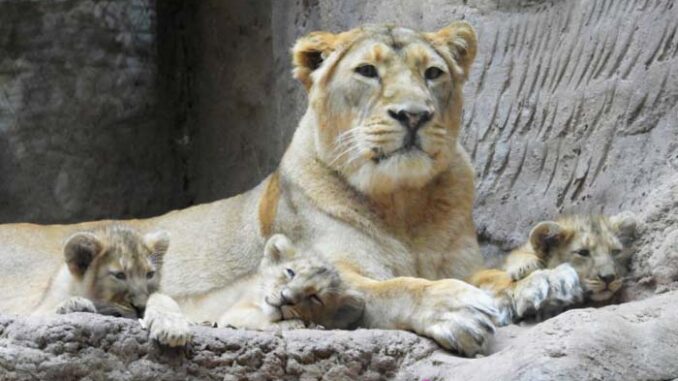
23.3.2026 – Source: Tiergarten Nürnberg, Photos by Petra Ballon
There are new arrivals among the Asian lions at Nuremberg Zoo. The cubs were born on 26th of December 2025 and their proud parents are mother Aaray and father Kiron.

Visitors haven’t been able to see the cubs during their first months. As lions, like most predators, are very sensitive to disturbance during the early rearing phase, the Predator House has been closed. However, now the visitors can meet the lion family.


Four lion cubs (three males and one female) have been officially presented and began appearing in the predator house in March 2026, named Chandra, Vihaan, Teyas, and Nikita.
It was almost impossible to catch all four in a same photo ….


The keepers haven’t been approaching Aarany and her cubs. “Aarany should be allowed to raise her cubs with as little disturbance as possible. Contact with the keepers could upset her. However, the keepers were keeping an eye on her via a camera,” says zoo veterinarian and curator Dr Hermann Will. The male lion Kiron has been with her. “We noticed during her last litter two years ago that Aarany is calmer and more relaxed in Kiron’s presence, so we made a conscious decision to keep the two together,” explains Dr Hermann Will. Kiron was present at the birth and now spends a lot of time with his family.

The lioness Aarany was born on 4 May 2016 at Aalborg Zoo in Denmark and arrived at the zoo in 2018. The male lion Kiron was born on 14 April 2018 at Frankfurt Zoo and moved to Nuremberg in 2022. By 2023, the pair had already successfully raised two cubs – Indica and Jadoo. Both now live in other zoos. Indica moved to Łódź Zoo in Poland in May this year, whilst Jadoo moved to Zurich Zoo in October.


So sweet, so innocent, so heart warming to see!


Critically Endangered Species
The International Union for Conservation of Nature (IUCN) classifies Asian lions as ‘critically endangered’. Currently, there is only a single population in Gir National Park in India and the surrounding areas, which, according to 2017 estimates, is home to around 630 animals. The population is relatively stable but cannot grow or expand its range, as the national park has reached its carrying capacity. Due to the very limited range, unforeseeable events such as disease or forest fires can threaten the entire population. Reserve populations in zoos play a crucial role in this context.
The breeding and care of the approximately 130 Asian lions currently housed in a total of 41 zoos belonging to the European Association of Zoos and Aquaria (EAZA) is coordinated on a scientific basis through a European Endangered Species Programme (EAZA Ex-situ Programme, or EEP for short). The aim is to maintain the greatest possible genetic diversity within the population.
Einfach nur herzig und Knuddelalarm!!! 💓💓💓 Und liebe Mama! 💓
Liebe Petra!
Vielen Dank für die wunderbaren Bilder. Die Löwenkinder sind schön.
Hugs
Ludmila
Liebe Petra!
Was für niedliche Bilder der bezaubernden Löwenkinder! Kleine Raubkatzen sind immer zauberhaft und hier sind sie gleich zu viert. Wunderbar, dass der Vater dabei bleiben konnte! Aray und Kiron mit ihren Jungtieren sind zur Zeit bestimmt die Stars im Nürnberger Zoo.
Danke, dass Du sie uns zeigst!
Viele Grüße
Anke