
20.2.2026 – Source: Ranua Wildlife Park
Adapted to steppe and semi-desert conditions, the Turkmenian kulans live most of the year in small groups, moving between feeding areas and water sources. As winter approaches, they gather into large herds of up to a thousand individuals and move to more sheltered areas, such as valleys and mountain passes. In winter, they also obtain sufficient moisture from snow. ❄️ The need for conservation is high. 🌍

Asian wild asses, such as the Turkmenian kulan, once roamed vast areas from the Mediterranean to eastern Mongolia. Today, their range has been reduced to a fraction of its original extent. Major threats include the loss of grazing areas and water sources, poaching, and diseases spread by livestock. What can you do? 👀 Visit, learn, and share knowledge. Zoo visits support research and conservation work, and by sharing what you learn, you help make the kulan and its conservation more visible. Turkmenian kulans are part of the European Ex situ Programme.
The crisp frost and a lovely moose invite you to a peaceful walk and to enjoy winter at your own pace ❄️

Nearly 100 Arctic fox litters were recorded in Fennoscandia last year ✨ According to Metsähallitus’ Parks & Wildlife Finland, a total of 97 litters were recorded: 56 in Sweden, 38 in Norway and 3 in Finland. The model-based estimate of the Arctic fox population is 526 adult individuals, slightly lower than the estimate for 2024. Litter numbers were influenced in particular by the poor small rodent situation in 2025.

Over the long term, however, the population has increased significantly compared to the critical situation in the early 2000s. The Arctic fox remains critically endangered, and conservation measures such as supplementary feeding and efforts to strengthen genetic diversity are essential for monitoring and safeguarding the population.
P.S. The video shows a young Arctic fox, Tihku, searching for food.
One month ago, our Bukhara urials arrived at Ranua and have settled in beautifully! 🧡 The siblings enjoy each other’s company, treats are eagerly eaten, and life in their new environment has started calmly and smoothly. 🐏 A Bukhara urial ram’s horns can grow up to an impressive one metre in length. During the autumn rut, rams measure their strength by clashing horns, and horn size often determines their rank within the group.
These striking horns are also one of the reasons for overhunting and pose a significant threat to the species’ survival. In areas managed by local communities, carefully regulated trophy hunting can, at best, support conservation by reducing poaching through generated income. Nevertheless, protected areas and effective monitoring remain essential for the future of the species. 🌿

Kara and Inuvik
Our new polar bears arrived at Ranua Resort in December and have since settled into their Arctic environment. With their powerful presence and calm confidence, they embody the spirit of the north. Their story is one of respect, care, and a deep connection to the Arctic world they call home.
Kara is a young female polar bear who arrived from Mulhouse Zoo in France. She was born in November 2020.


Kara is temperamental and playful, especially with different toys and stimuli, and she explores her surroundings with curiosity. We noticed this already during her first week in Ranua, as Kara explored the area boldly and curiously, often throwing herself into snow games.


Inuvik is a female polar bear who arrived from Copenhagen Zoo in Denmark and was born in December 2019. Her mother is Noel and her father is Nord – the same male who lived in Ranua for a while after Inuvik’s birth. Sadly Nord died a few months after his arrival.

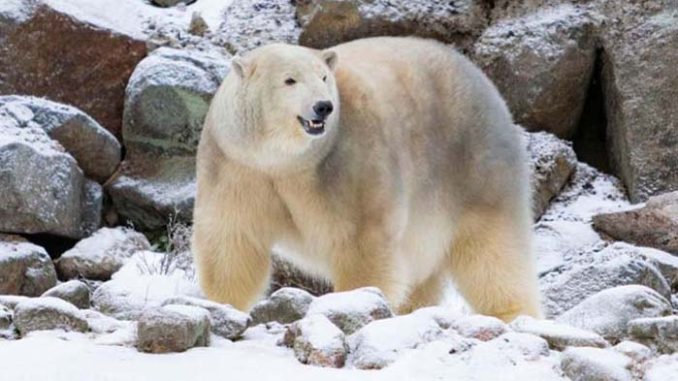
According to the keepers, Inuvik is a sociable, active, and friendly bear who enjoys the company of others, but can also be a little short tempered. Inuvik is calmer than Kara and likes to sit still and observe what is going on around him. Inuvik also differs from Kara with its more voluminous appearance.


Dental check! 🐻❄️
One morning, after getting into a “working mood,” Kara delighted her keeper by opening her mouth (pictured). This is one of the skills polar bears are trained for, allowing the condition of the teeth to be monitored as part of daily routines. Kara received the foundation of her training at her previous zoo, and here at Ranua Wildlife Park these familiar skills are now being refreshed and further developed.
Polar bear health and wellbeing are monitored in many ways, with training being one important part of that work. Training sessions always take place on the bear’s terms: voluntarily and in cooperation with the keepers – and are also enjoyable moments for the animals, with plenty of praise and treats as rewards ✨

This beautiful lady is Venus

🐻❄️🐻❄️ Two polar bears, one very fluffy moment – Inuvik and Kara.

Playtime, polar bear style! 🐻❄️
Der Fuchs ist sehr gut getarnt.
Das Ballspiel ist klasse! 🙂
Nachts kommt man hier besser durch…
Dear Mervi!
Thank you for the interesting story and the fine story of the nice polarbears!
Liebe Mervi, vielen Dank für die Informationen aus Ranua!
Von dieser Eselart wusste ich bisher nichts.
Hoffen wir, dass das Schutzprogramm sie vor dem Aussterben retten kann.
Die 3 Bären scheinen schon gut miteinander auszukommen und Kara wird sich auch bald eingewöhnen. Schnee gefällt allen Eisbären und macht neugierig auf Entdeckungen.
Ja, du hast recht, knutis Magazine hat Starallüren wie la Donna!
Liebe Grüße
Britta-Gudrun
Vielen Dank für die Fotogrüße, sowie die Informationen aus dem Schneeparadies Ranua Ressort! 👍
Kara und Inuvik haben es dort sehr gut getroffen, zudem verstehen sich die beiden gut miteinander, trotz ihrem unterschiedlichen Temperament!🐻❄️🐻❄️❤
Venus und die beiden Mädels sehen
prächtig aus…🐻❄️🐻❄️🐻❄️👌😊
Dear Mervi!
Even though I’m so fed up with winter, I’m happy for all the animals in Ranua who love winter that it’s still hanging around a bit longer there. They all seem to be doing well, and that’s the main thing. I especially liked the special donkeys and the moose’s nose. I hope Kara’s fur will soon be as fluffy as that of Venus and Inuvik!
Hugs
Anke
Dear Mervi!
Thank you for the winter pictures from Ranua. I hope Kara’s fur will be better in Ranua.
The play with the ball is very nice.
Hugs
Ludmila